

Table of Contents
In the bustling urban landscape of Chennai—from the tech corridors of OMR to the heritage streets of Mylapore—finding a moment of true stillness can feel like a luxury. For many, the traditional indoor studio is no longer the only sanctuary. Increasingly, yoga enthusiasts are trading air-conditioned rooms for the open air of Besant Nagar beach or the greenery of Anna Nagar Tower Park.
You might find yourself wondering: Why are so many people choosing to move their practice outdoors? It isn’t just about the scenery. It is about a fundamental shift in how we experience movement. Practicing under the open sky, feeling the morning breeze, and hearing the natural rhythms of the city creates a “holistic resonance” that indoor walls simply cannot replicate.
In this guide, we will explore the science, the soul, and the practical joy behind outdoor yoga. Whether you are a curious beginner or a seasoned practitioner, you will discover why stepping off the mat and onto the earth might just be the upgrade your wellness journey needs.

Outdoor yoga is the practice of performing yoga asanas (postures), pranayama (breathwork), and meditation in natural environments like parks, beaches, or gardens. Unlike studio practice, it integrates the surrounding elements—sunlight, wind, and natural sounds—into the session, turning the environment into an active partner in your wellness experience.
We spend the vast majority of our lives in “controlled” environments—offices, apartments, and cars—which often disconnect us from our circadian rhythms. Outdoor yoga acts as a bridge, bringing us back to the natural cycles of light and air.
For a city dweller, this matters because “Green Exercise”—physical activity performed in natural settings—has been shown to lower cortisol (the stress hormone) levels faster than indoor movement. When you practice outdoors, you aren’t just stretching your muscles; you are grounding your nervous system, improving your sleep quality, and giving your lungs a dose of cleaner, more oxygen-rich air.
Practicing outside changes the mechanics of your flow. Here is a typical experience:
- Setting the Foundation: You choose a spot that is relatively flat, whether it is sand at Thiruvanmiyur beach or grass in a local park.
- Sensory Integration: You begin by noticing the temperature on your skin and the sounds around you, using these inputs to anchor your focus instead of trying to ignore them.
- Adjusting to Terrain: Because the ground is rarely perfectly flat, your stabilizer muscles engage more deeply to keep you balanced, adding a functional strength component to your practice.
- Closing: You end with Savasana (corpse pose), but instead of a ceiling, your view is the sky, allowing for a profound sense of expansion and connection.
- Core Stability: Practicing on uneven surfaces—like sand or grass—forces your body to recruit smaller stabilizer muscles, increasing your overall balance and strength.
- Respiratory Health: Fresh, saline-rich air (if by the coast) or oxygen-rich air (if in a park) can improve lung capacity and boost your immune system.
- Vitamin D: Morning sessions provide a natural, healthy dose of sunlight, which is essential for bone health and mood regulation.
- Stress Reduction: Natural environments naturally lower your heart rate and blood pressure, promoting a deep state of relaxation.
- Heightened Mindfulness: The need to pay attention to your surroundings (like a breeze or a bird call) keeps you firmly in the present moment, making it harder for the mind to wander into work stress.
- Community Connection: Outdoor classes often feel less “exclusive” than studios, fostering a sense of belonging and social support.
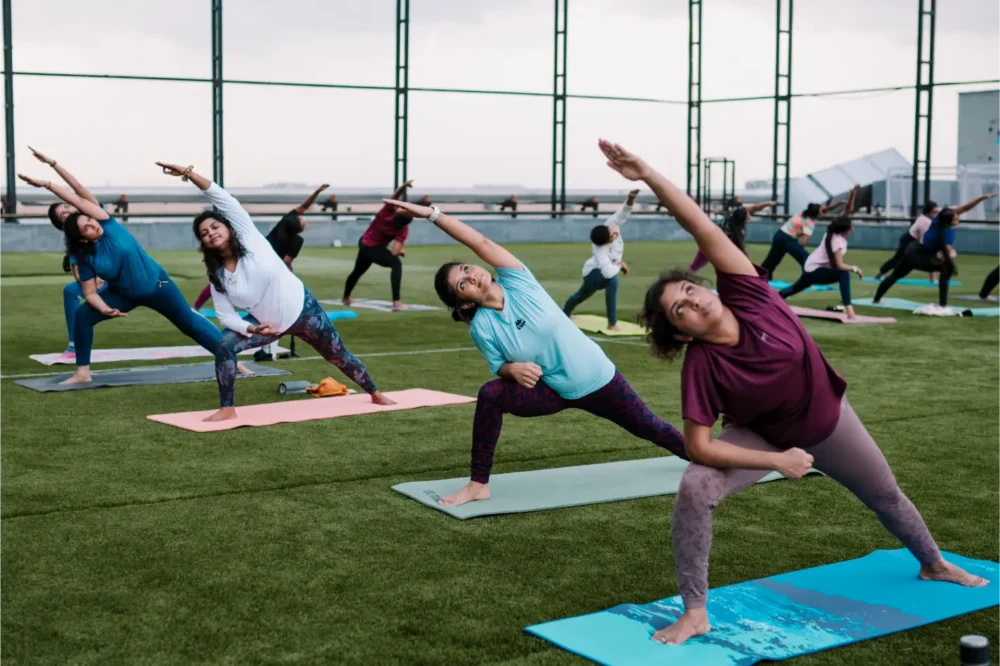
If you are new to this, don’t worry about being “perfect.” Just start with these simple steps:
- Choose Your Time Wisely: In Chennai, the “Golden Window” is between 5:30 AM and 7:30 AM. This avoids the harsh midday sun and ensures a cooler, more comfortable session.
- Keep it Simple: Bring a high-grip yoga mat and a towel. You don’t need fancy props; let nature provide the challenge.
- Start with a Group: Joining a community-led outdoor session is a great way to learn safety and find the best spots in your neighborhood without having to venture out alone.
- “Outdoor yoga is too distracting”: Many people fear the noise of traffic or birds. However, the goal of outdoor yoga is acceptance. Learning to stay centered despite external noise is one of the most powerful skills you can build.
- “I need a studio to get a ‘real’ workout”: The truth is, outdoor yoga can be more intense because of the terrain. You aren’t just holding a pose; you are holding it while balancing on shifting ground.
- “It’s dirty”: Bring a durable mat or a cotton dhurrie. A little bit of dust is a small price to pay for the grounding benefits of connecting with the earth.
- Hydration is Key: Chennai is humid. Always bring more water than you think you need, and sip it before and after your practice.
- Sun Protection: Use sunscreen even for early morning sessions. The tropical sun is powerful.
- Check the Surface: Before laying your mat, clear the ground of any sharp sticks or rocks. A quick 30-second sweep can save your knees.
- Layering: Chennai mornings can be breezy. Wear breathable layers that you can easily take off as you warm up.
Karthik spent his entire week in a climate-controlled cubicle. On Sunday mornings, he attended an outdoor session at a park near his home. He found that the “Green Exercise”—exercising in a natural setting—helped him release the stiffness in his back and shoulders much faster than his gym workouts, and the morning sun left him feeling energized for the week.
Priya felt disconnected after having a baby and struggled to find time for a studio class. She started joining a group of neighbors for yoga at the beach. The sense of community, combined with the rhythmic sound of the waves, helped her rebuild her core strength without the pressure of a structured studio environment. It became her primary source of social connection.
1. Is outdoor yoga safe for beginners? Yes, it is highly adaptable. Start with slow-paced Hatha or Vinyasa flows and always listen to your body’s limits.
2. Where are the best places in Chennai for outdoor yoga? Besant Nagar Beach, Thiruvanmiyur Beach, Anna Nagar Tower Park, and Nageswara Rao Park (Mylapore) are highly popular, safe, and scenic spots.
3. Do I need a special mat for outdoor practice? A high-grip, anti-slip mat is ideal. Some people prefer a thick cotton mat or a towel to practice directly on the grass.
4. What should I do if it rains? In Chennai, most outdoor groups have a “Plan B” or a rainy-day policy. Always check with your instructor before heading out if the weather looks uncertain.
5. Is there an entry fee for outdoor classes? Most beach and park sessions are community-run and very affordable, often ranging from ₹100 to ₹250 per session, or free if you practice solo.
6. Is it safe to practice alone outdoors? Chennai’s popular parks and beaches are generally safe during the early morning hours, which are filled with walkers and fitness enthusiasts. Stick to well-populated areas.
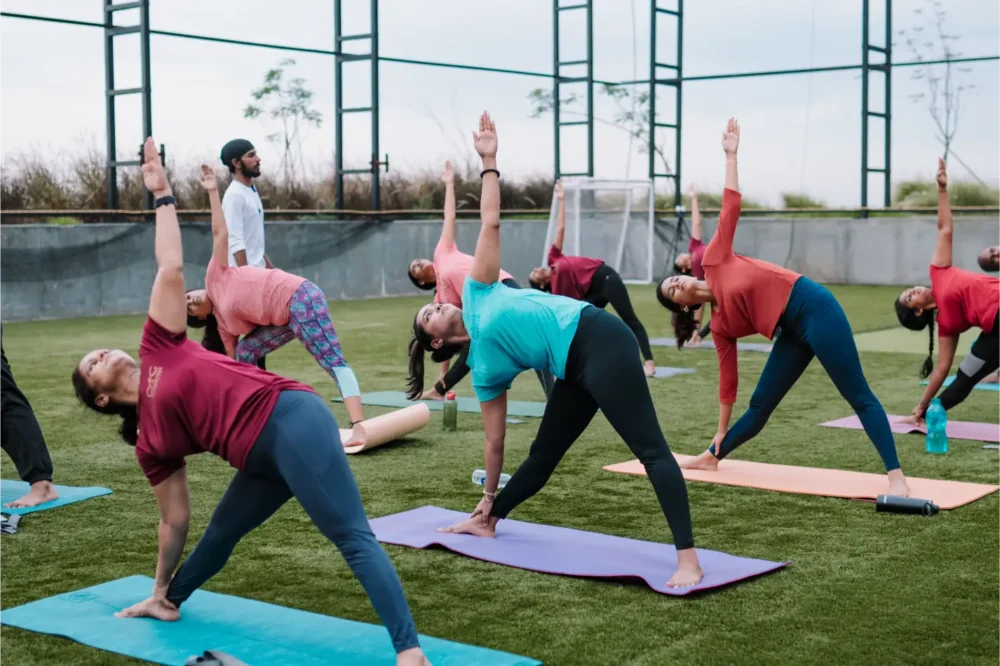
Outdoor yoga is more than just a fitness trend; it is a return to a more natural way of being. It challenges you, calms you, and reminds you that you are part of something much larger than your daily to-do list.
In a city that never stops, choosing to take your mat outside is a radical act of self-care. It allows you to breathe deeper, stretch further, and find a rhythm that feels authentic to you. So, leave the walls behind, find a patch of grass or a stretch of sand, and see what happens when you let nature guide your practice.
Would you like me to help you find a community-led outdoor yoga group near your specific neighborhood in Chennai?
