
Table of Contents
Menswear today is not lacking in options.
If anything, it suffers from excess.
From rapidly changing collections to endless discounts, clothing has become more accessible than ever. But accessibility has also introduced a deeper question—one that modern consumers are increasingly asking:
Is more clothing actually better clothing?
This is where the debate between premium vs fast fashion for men becomes relevant.
It is not just about price.
It is about:
- Longevity
- Comfort
- Environmental impact
- Daily usability
Choosing between the two is no longer just a style decision.
It is a lifestyle decision.
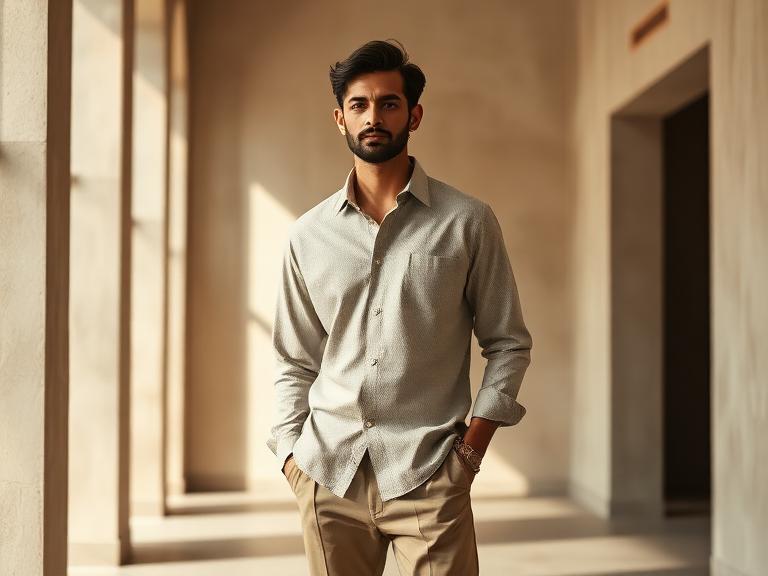
| Criteria | Fast Fashion | Premium Menswear |
|---|---|---|
| Price | Low | Moderate–High |
| Fabric Quality | Variable | High |
| Durability | Low | High |
| Comfort | Moderate | Excellent |
| Longevity | Short | Long |
| Sustainability | Low | Higher |
| Cost per Wear | High | Low |
Fast fashion is built on speed.
It focuses on:
- Rapid production cycles
- Trend replication
- Low-cost manufacturing
The goal is simple: make clothing quickly and sell it cheaply.
While it offers variety, it often compromises on:
- Fabric quality
- Construction
- Longevity
Premium menswear takes a different approach.
It focuses on:
- Fabric integrity
- Craftsmanship
- Timeless design
- Long-term usability
Rather than chasing trends, it builds enduring wardrobes.
Fast fashion:
- Often uses synthetic or low-grade materials
- Prioritizes cost over comfort
Premium menswear:
- Uses natural fabrics like cotton and linen
- Focuses on breathability and feel
Fast fashion:
- Mass production
- Minimal attention to detail
Premium:
- Strong stitching
- Better finishing
- Structured design
Fast fashion:
- Trend-driven fits
- Often inconsistent
Premium:
- Timeless silhouettes
- Consistent sizing
- Focus on comfort
Fast fashion:
- Designed for short-term use
Premium:
- Designed to last multiple seasons
Fast fashion:
- High waste generation
- Unsustainable production
Premium:
- Lower consumption cycles
- Better material sourcing

Fast fashion:
- Thin fabrics
- Quick wear-out
Premium:
- Durable cotton
- Better structure
Fast fashion:
- Lose shape quickly
Premium:
- Retain structure
- Better fabric weight
Fast fashion:
- Weak stitching
- Poor fit over time
Premium:
- Long-lasting construction
- Better drape
- Polyester
- Low-grade cotton
- Synthetic blends
- Long-staple cotton
- Linen
- Natural blends
Fast fashion garments:
- Fade quickly
- Lose shape
- Require frequent replacement
Premium garments:
- Maintain structure
- Improve with wear
- Last significantly longer
| Factor | Fast Fashion | Premium Clothing |
|---|---|---|
| Initial Cost | Low | Higher |
| Replacement Frequency | High | Low |
| Cost per Wear | High | Low |
What appears cheaper initially often becomes more expensive over time.
- Short-term needs
- Trend experimentation
- Occasional wear
- Everyday wear
- Professionals
- Minimal wardrobes
- Long-term investment
Fast fashion often looks good initially.
But over time:
- Fabrics feel rough
- Fit deteriorates
- Comfort reduces
Premium clothing offers:
- Softness
- Breathability
- Consistent comfort
The difference becomes evident not in the mirror—but in daily wear.
Premium clothing:
- Holds structure
- Looks refined
- Ages well
Fast fashion:
- Loses shape
- Appears worn quickly
Even simple outfits look better when built on quality.
- Buying based on price alone
- Ignoring fabric composition
- Overloading wardrobe with low-quality items
- Choosing trends over longevity

Yes, due to better durability and comfort.
Because of low-cost materials and mass production.
Premium clothing.
Not always, but not ideal for daily wear.
Cotton, linen, and natural blends.
Yes, but prioritize premium for essentials.
The cost divided by the number of times you wear it.
Long-term value and comfort.
The choice between premium and fast fashion is not about affordability.
It is about perspective.
Fast fashion offers:
- Variety
- Accessibility
- Immediate gratification
Premium menswear offers:
- Longevity
- Comfort
- Consistency
In a world where consumption is easy, restraint becomes valuable.
CRCLE Studio reflects this philosophy—designing menswear centered on fabric, texture, and intentional design, where clothing is not disposable, but dependable.
Because the best wardrobe is not the one you replace often.
It is the one you rely on—every day.
